
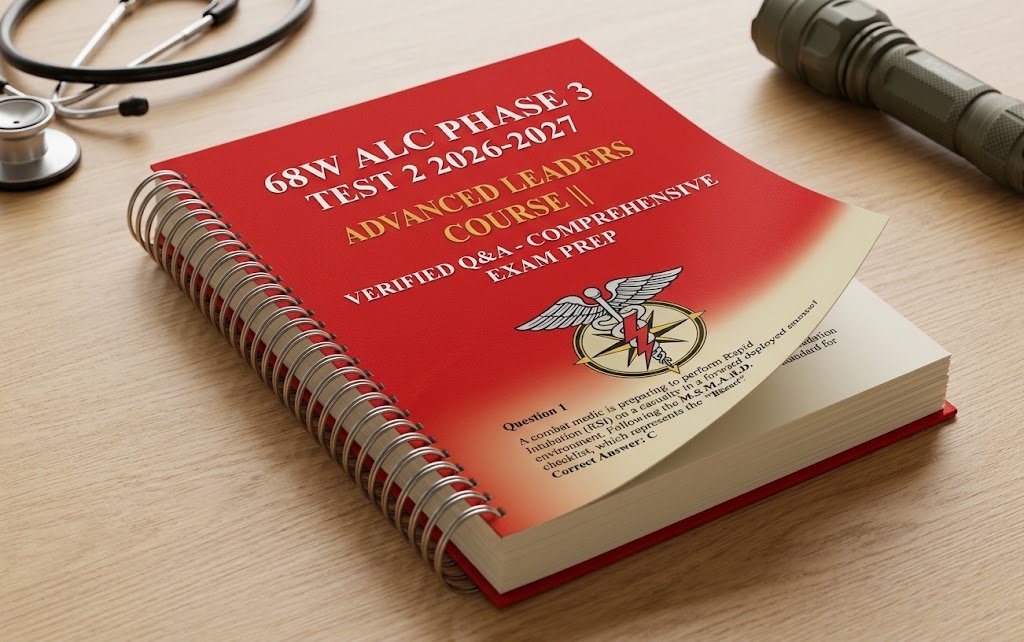
Master your 68W Advanced Leaders Course (ALC) Phase 3 examination with this comprehensive 2026–2027 study guide and practice test bank. Tailored specifically for military combat medics and tactical healthcare providers preparing for advanced leadership roles, this guide features verified questions with detailed rationale explanations to ensure deep operational understanding.
Key Content & Topics Covered:
-
Airway & Resuscitation Management: Complete coverage of Rapid Sequence Intubation (RSI) protocols using the M.S.M.A.I.D. checklist, standard-of-care intubation equipment selection, and proper dosing for induction agents (Ketamine, Etomidate, Midazolam).
-
Neuromuscular Blockers & Pharmacotherapy: Breakdown of paralytics in austere environments, comparing onset time, storage/refrigeration requirements, and safety profiles of Rocuronium, Vecuronium, and Succinylcholine.
-
Capnography & Respiratory Monitoring: Detailed interpretation of continuous $ETCO_2$ capnogram waveforms across all phases, physiological target ranges ($35\text{–}45\text{ mmHg}$), and immediate troubleshooting for sudden baseline drops or loss of cardiac output.
-
Thoracic Trauma & Surgical Interventions: Practical application of needle decompression (NDC catheter sizing and anatomical landmarks: 5th intercostal space anterior axillary line) and fluid titration using permissive hypotension principles ($SBP \sim 80\text{ mmHg}$).
-
Traumatic Brain Injury (TBI) & Neurological Care: Step-by-step scoring for Glasgow Coma Scale (GCS), identification of Cushing’s Triad signaling impending herniation, and Point-of-Care Ultrasound (POCUS) protocols for measuring Optic Nerve Sheath Diameter (ONSD).
-
Advanced Cardiac & ACLS Protocols: Cardiac electrophysiology (depolarization and repolarization), intrinsic pacemaker rates (SA Node, AV Node, Purkinje Fibers), EKG strip reading, and emergency administration of Adenosine, Amiodarone, Atropine, and Magnesium Sulfate.
-
Point-of-Care Ultrasound (POCUS): E-FAST examination techniques, distinguishing between normal pleural sliding (“Seashore Sign”) and pneumothorax (“Barcode/Stratosphere Sign”), and identifying fluid collections (anechoic readings).
Designed for self-directed study, classroom review, and field refreshers, this study prep equips candidates with the critical decision-making skills required for success on exam day and in real-world combat casualty care.


Reviews
There are no reviews yet.